tl;dr – I point out a solution to Alex’s question about where (and what) the triangle in his mind’s eye actually is and explain the implications of this solution with respect to the nature of the self.
The Plea
In Alex O’Connor’s YouTube video How Does Consciousness Actually Exist?, he challenges the viewer to explain where the triangle he is visualizing in his mind’s eye is: “So please somebody, anybody tell me where this triangle is. I’m getting quite desperate.”. And offers a $50 reward to “anyone who can find the damn triangle.”
Alex contends that if you peer into someone’s brain while they are visualizing a triangle, there is nothing we can find in the brain that is the experience of that triangle. He acknowledges we can find evidence of the experience—such as neuronal firing patterns. But Alex argues that while the evidence may correlate with the visualization, it is not the experience itself.
Alex’s full plea:
“you can fully explain all of the brain activity that goes along with, correlates with, maybe even somehow causes conscious experience but that doesn’t make them the same thing. And I’m seeing a triangle. I’m not seeing a bunch of neurons firing. That might be what’s really going on in my brain but that’s not what I’m seeing in my head. So please somebody, anybody tell me where this triangle is. I’m getting quite desperate. $50 reward for anyone who can find the damn triangle.”
Most attempts at answering this question such as the triangle exists as “distributed information” or the triangle exists as a “computational process that represents the triangle” are woefully unsatisfying both intuitively and upon deeper inspection. But I won’t delve too much on those criticisms as O’Connor is already unconvinced by those arguments. What I really want to do is introduce a view that satisfies O’Connor’s question in a formal and testable way.
A Solution: Qualia Formalism & Physicalism
Qualia Formalism
Qualia Formalism is the view that “for any given conscious experience, there exists – in principle – a mathematical object isomorphic to its phenomenology” (Principia Qualia: 2016, Michael Edward Johnson, page 25). In other words, for any conscious experience, the entirety of the experience can be mapped and fully described by a mathematical object. At first this claim may seem a bit outlandish since subjective experience is rarely considered to be something one can investigate with mathematical rigor. But this is the result of the greatest mistake of the enlightenment: conflating subjective experience with subjectivity and consequently exiling both from the domain of science. While subjectivity is certainly antithetical to the scientific method, the structure of subjective experience itself can be studied rigorously. A wonderful example is the CIELAB color space, which is the mapping of phenomenal color in perceptual space. Qualia Formalism asserts that this kind of modeling is possible with all aspects of conscious experience.
Physicalism
Physicalism states that “consciousness is what certain physical processes feel like from the inside” (Principia Qualia, page 60). In this view consciousness does not need to emerge from anything, but instead is always present and the content and character of consciousness is the direct result of the physical processes corresponding to that qualia. This idea sounds like Panpsychism (“consciousness is everywhere”), but it is distinct and has more explanatory power. Physicalism makes possible specific and testable claims of the relationship between physical states and experience for example. Questions like “how can there be distinct selves if consciousness is ‘everywhere’” can be addressed rigorously and promising solutions exist. More on this later.
For the sake of answering this question (“where is the triangle”), let us assume that the electromagnetic field (as Susan Pockett and Michael McFadden suggest) is the field responsible for experience; the entirety of the content and character of an experience is determined by the state of the EM field that makes up that experience.
The Triangle
If this flavor of Physicalism (let’s call it EM-Physicalism) is true, the triangle you are experiencing exists inside the brain as a state of the EM field. If we were to peer inside your brain while you visualized a triangle with your eyes closed, we would find that the mathematical description of the state of the EM field (a 3D vector field) inside your brain corresponds exactly to your experience of a triangle. An EM state that is the experience of a triangle perhaps may look like this field: YouTube: Triangle in the EM Field. This demo is likely naive because I assume that the vector field’s euclidean geometry maps exactly to the euclidean geometry of the experience but nonetheless I think this example is illustrative.
A snapshot of a simulation of the electromagnetic field oscillating in the shape of a triangle. It is plausible that some of the billions of neurons in the brain are responsible for perturbing the EM field in this way to create the visual qualia of a triangle in one’s mind’s eye. The mapping from vector field to qualia, though in my estimation is direct but more complicated than the one pictured in this example.
So if Qualia Formalism, Physicalism (as defined by Johnson in PQ), and the EM Theory of Consciousness are true, the neurons firing certainly would not be the same thing as the experience but the configuration of the EM field in Alex’s brain WOULD be the same thing as the experience. The mathematical object describing the EM field would perfectly and fully describe the experience and the EM field itself in that state would be that experience. One of the many purposes of the neurons in the brain is to manipulate the EM field to perform experiential processing (Qualia Computing).
This view has extraordinary explanatory power and its implications are radical. For example, it implies that if the EM field has this configuration anywhere in the universe then an experience of a triangle is happening there. This begs the question: why am I not experiencing the entirety of the universe’s EM field? Luckily, EM-Physicalism has an answer.
But what about the Self?
On the surface EM-Physicalism seems like Panpsychism in that it sidesteps the hard problem of consciousness but leaves a big question unanswered: how does a unified field of consciousness give rise to distinct minds? Alex asks in his interview with Sam Harris: “when a thought arises in my head, it isn’t arising in YOUR head…. so if the self is an illusion, then what is the thing that the thought like that can happen to that makes it such that you can have the thought but I can’t have your thought”. Alex cuts to the heart of the nature of the self by asking what the boundaries of consciousness are. What makes qualia happening in his field of awareness inaccessible to someone else’s field of awareness. Here it becomes clear that Panpsychism is trading the hard problem of consciousness for what we might call the “problem of distinct minds”. In the context of Physicalism, this is called the “Boundary Problem” (The Boundary Problem for Experiencing Subjects (Rosenberg 1998)) . But Physicalism, or at least EM-Physicalism, need not make this compromise because it offers an elegant solution to the Boundary Problem: Topological Segmentation.
Andrés from the Qualia Research Institute explains this beautifully in Topological Segmentation of the EM Field: A New Approach to the Boundary Problem of Consciousness. The tl;dr is that topological pockets in the electromagnetic field may explain the intersubjective boundaries that produce distinct minds. Topological pockets partition a field with hard, causally significant borders. If the EM field is a single god-mind then topological pockets in that field are partitioned mini-minds. This process is similar to Bernardo Kastrup’s idea of a person’s mind being a dissociated part of the cosmic mind. Andrés makes the case that these topological pockets are computationally useful and were recruited by evolution. One of the functions of the brain may be to pinch off a chunk of the EM field for computational purposes, creating a mini-mind in the process. I expand on this idea with my co-authors Andrés Gomez-Emilsson and Chris Percy in the article “The Electrostatic Brain: How a Web of Neurons Generates the World-Simulation that is You“. In that article we argue that these partitioned mini-minds were recruited by evolution to instantiate the real-time world simulation we inhabit and speculate on the potential mechanics of that simulation assuming EM-Physicalism is true.
This work is heavily inspired by the work of Andrés Gómez Emilsson and the Qualia Research Institute, Chris Percy, Mike Johnson (Principia Qualia), Steven Lehar (Cartoon Epistemology and The Grand Illusion), Johnjoe McFadden and Susan Pockett (Electromagnetic Theories of Consciousness).
Part 1: How the brain leverages the electromagnetic field to create a real-time world simulation via non-linear wave computing.
Part 2: Demonstrating the explanatory power of this theory using:
Wave-like behavior in perceptual experience.
Resolution of computational challenges, such as spatial auditory processing.
Accurate implications regarding visual perceptions.
Part 3: Speculating on the mechanics behind the dynamic construction of the simulation.
Part 4: Connecting these mechanics to the nature of the self, non-duality, and the future of consciousness research.
Part 5: The epistemic status of the theory and potential future research directions.
Part 1 – The Simulation
The brain–the most celebrated human organ–enables abstract reasoning, fine motor control, navigation of complex social environments, and, of course, learning. It is no wonder that natural selection has evolved this tool to best our fellow Darwinian competitors. Of all of these perks, one feature stands out as particularly evolutionarily useful: the ability to instantiate a real-time world simulation (Lehar 2010) as depicted in the image below.
An illustration of the world simulation from Lehar’s Cartoon Epistemology
This world simulation is complex, immersive, and allows us to reason spatially in real-time, an enormously useful ability for survival (how else would you be able to duck under branches and leap over fallen trees while running away from predators in the jungle?).
This simulation is so useful that evolution decided it was worth building a heavy, delicate, and calorically expensive machine (consuming around 20 watts! (Kováč 2010)) that requires charging 8 hours a day to run it.
One of the most enjoyable ways to grasp the “simulationness” of your experience firsthand is by listening to a symphony on a pair of high-quality speakers. Instead of perceiving the sound as originating solely from the speakers, the brain creates an illusion of spatial positioning, placing the instruments in different locations within your perceptual space. Good speakers quite literally hack your brain into projecting fraudulent spatial information onto the entire world simulation.
What is this simulation made out of though? What are its functional parts? How does a squishy, wet, and electrically intertwined sponge generate the 3D simulation you are inhabiting right now? The Brain as a Non-linear Optical Computer (BAANLOC) theory proposes that the brain enlists electromagnetic waves to create a powerful computational medium. In other words, evolution has coopted the EM field for its massive parallelism, holistic behavior, and self-organizing tendencies, to unleash its computational potential with non-linear wave interactions. In this article we describe supporting evidence for the Brain as a Non-linear Optical Computer theory and speculate on how it may be implemented by existing neuronal mechanics in the brain.
The undulation, breathing, and the geometric nature of psychedelic visuals suggests waves traveling over closed surfaces. Kaleidoscopic visuals, for example, can be explained by wave propagations that wrap back onto themselves. Waves traveling with little impedance on spherical surfaces generate geometric patterns via repeated self-interference. Below is a simple demonstration that creates psychedelic visuals purely via this mechanic.
A Natural Solution to Spatial Audio using Wave Computing
A practical example of wave computation comes from how the mind performs auditory localization. Test this out for yourself by approaching a busy street and closing your eyes. Pay close attention to the position, direction, and speed of the cars as they approach and pass you. You may be surprised how vivid and immediate the experience of space is, solely from your sense of hearing. The problem of localizing sound sources is being continually solved by the brain. Acoustic cameras attempt to solve the same problem using classical (digital) computers (see Acoustic cameras can SEE sound for an example). For a digital computer, however, the problem is so computationally heavy that it is difficult to achieve in real-time. So how does the human brain, consuming a mere 20 Watts while also processing visual information, abstract thoughts, maintaining homeostasis, etc, perform such a computationally expensive task in real-time? Wave computing of course!
We speculate that the brain’s solution to this problem is implemented by two wave-sources on opposite ends of a medium. The waves they generate correspond to the auditory stimuli from each ear. The direction of a sound creates a delay between the signals reaching each ear and consequently a phase shift between the wave-sources (illustrated below).
An interference pattern in the medium is produced and in the steady-state, the position of the sound source can be inferred by the phase of the standing waves. Wave computing solves this problem almost too easily. Below is an illustration of the steady state of the medium with a moving sound source.
Testing Implications of Wave Computing
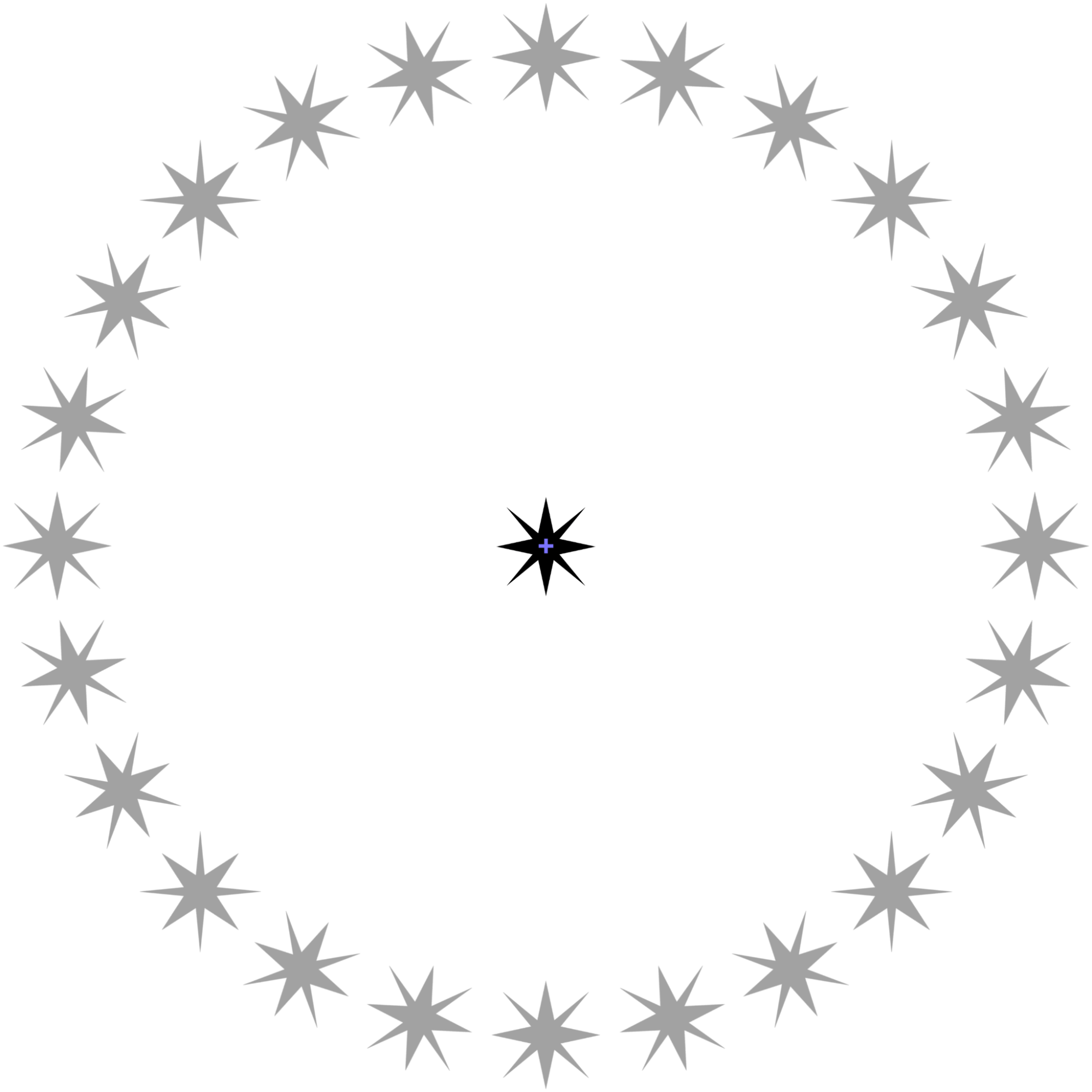
BAANLOC also predicts certain behaviors. For example, one consequence of wave computing is that waves with higher frequency can resolve finer details. Assuming waves can travel throughout the whole medium, this implies that introducing high frequency information into your experiential field in one place will increase the resolution in other locations of that experience. We created this illusion to test this implication.
An illusion Bijan developed to demonstrate artifacts of wave behavior in the visual field. To experience the effect: focus your gaze on the cross in the middle of the left image and move your attention (but not your eyes!) to the stars in the periphery. Now do the same with the right image. Notice how the stars in the periphery become sharper if the star in the middle is sharp. The effect is most apparent if you switch images between the images quickly on a device like a tablet. We call this phenomenon the Fakhri Effect.
With your gaze focused on the cross in the middle of the first image, move your attention (but not your eyes!) to the stars in the periphery. Now do the same with the right image. Notice how the stars in the periphery become sharper if the star in the middle is sharp. This effect is unintuitive but easily explained by wave computing: when high frequency information is introduced to the computational medium, edges are resolved higher fidelity. This is similar to how higher frequency light is required to resolve smaller features in photolithography. An example of this phenomenon is below:
Two simulations of a rabbit being bombarded with electromagnetic waves of low frequency (left) and high frequency (right) waves. Bijan ran these simulations to demonstrate the superior resolving power of high frequency waves with respect to features like edges and boundaries. The right image of the rabbit appears to be more well-defined than the left one throughout the simulation due to this property of waves.
The images above are from an EM simulation of a rabbit being bombarded with waves from all four sides. The wave sources in the left image are low frequency while on the right they are emitting at a much higher frequency. You can see that the right image of the rabbit appears to be much more well-defined than the left one, due to the superior resolving nature of the high frequency waves (FDTD Simulation Library).
Given the supporting evidence, let us assume that the BAANLOC theory is correct and your brain is an optical computer that creates your world simulation. How would the brain actually implement this optical simulator?
Part 3 – The Electrostatic Brain: the Mechanics of the EM World Simulation
We propose that objects in your world simulation are made of patches in the neuronal lattice with distinct electrostatic parameters. The interaction of light with matter is governed by the material’s electrostatic parameters permittivity and permeability. Light propagates undisturbed through a uniform medium but reflects and refracts when these properties vary spatially, which is the principle behind how lenses manipulate light. Objects in your visual field may correspond to patches of neuronal substrate whose properties differ from those of the surrounding substrate, creating electrostatic boundaries between object and the background. EM waves would reflect off of these boundaries and resonate within the patch. Additionally, the waves inside the patch would have a different phase shift between their electric and magnetic fields. The figure below illustrates this.
A patch of substrate shaped like a rabbit has a higher permittivity (epsilon = 6.3) than the surrounding material (epsilon = 1.0), causing EM waves to reflect off of and resonate inside of the patch. The waves inside the rabbit also differ in color in this simulation because the magnetic and electric portions of the wave are overlaid with different delays inside and outside of the rabbit corresponding to the differences in the object’s permittivity.
How does the neuronal lattice generate these patches? Let’s back up and talk about neurons. The brain can be thought of as a configurable electron soup. Neurons create electric potential gradients by segregating cations and anions, resulting in relatively static patterns in the electric field. They also generate dynamic patterns when they fire (illustrated in the image below). First by the cascade of ions that rush to equalize the gradient (waves in the electron field), and second by EM waves created by the movement of those charges. Whether a neuron is at rest, is currently firing, or has just fired will change the electrostatic properties of the neural substrate in and around the neuron. Speculatively, a neuron with open ion channels may exhibit a relatively high permittivity perpendicular to the cell walls, resulting in a surface that reflects electromagnetic waves. Conversely, a neuron with closed ion channels will be transparent to EM waves, as the arrested charges cannot perturb the wavefront.
In other words, the electrostatic composition of neural substrates drastically affects what patterns in the EM field can exist. Of course, these patterns do not need to be explicitly “rabbit-shaped” in the sense of 3D structures in the EM field or the neuronal lattice and the electron soups they configure. Patches with different permittivity and permeability would only need certain geometric isomorphisms to the relevant physical shape, in order for those elements to be represented within and bound together with other elements of a world simulation – with isomorphisms potentially established over temporal as well as spatial dimensions. Investigating the minimal properties of such isomorphisms and looking for them in the brain is an exciting area of empirical and computational research that would lead to direct testing of this aspect of the BAANLOC hypothesis.
The relative permittivity of a patch of material also has an effect on the spatial frequency of the waves transmitted through that material. The diagram below shows a wave beginning in a region of low permittivity entering into a region of high permittivity. You can see the wave slow down and spatial frequency increase as it moves into this region.
Diagram illustrating a wave transitioning from a region of low permittivity to a region of high permittivity. Notice how the wave slows down and the spatial frequency increases in the high permittivity region.
The spatial frequency (density) of waves may encode scale. Patches with high permittivity and thus high spatial density may appear larger in our experience than patches of low permittivity. While the size of the patches themselves at the implementation could be more Euclidean, which may explain the duality of size perception described at this timestamp of Steven Lehar’s video and hyperbolic geometry of experience: The Dimensions of Visual Experience (Lehar 2003).
These are just some examples of how the neuronal substrate of the brain can govern the propagation of EM waves to construct a world simulation. If EM theories of consciousness hold any water, we suspect these mechanisms are the primary drivers of the character of our conscious experience.
Part 4 – An Electrostatic Model of the Self and Enlightenment
Finally, the perception of a “self” that is distinct from your environment may be rooted in the electrostatic configuration of the neural substrate. The instantiation of the “self” in the world simulation may be a portion of the neural substrate that is electromagnetically denser than its surroundings: a patch of neurons with heightened electrostatic permittivity which encapsulates EM waves and increases their spatial frequency (like in the previous figure). The equalization of the permittivity of this patch of neurons with the surrounding neurons may be the undoing of the privileged self and the mechanism responsible for the realization of anatta (non-self). An enlightenment experience is a moment where this happens and you realize you are the entire world simulation, not just the avatar within it. The figure below illustrates this phenomenon.
A visualization of the Electrostatic Model of Enlightenment. Initially, electromagnetic waves resonate within a patch of neuronal substrate with high permittivity, creating the sensation of a separate self in one’s world simulation. If the permittivity of this patch equalizes with its surroundings, the EM waves may move uninhibited between what was the “self” and the rest of the world simulation. This may account for the dissolution of boundaries commonly reported during the moment of classical enlightenment (stream entry). Higher resolution version: YouTube with zoom: YouTube.
This perspective bridges ancient Eastern philosophy with contemporary neuroscience suggesting that meditation, psychedelics, and other consciousness-altering practices are radically modulating the electrostatic parameters of the brain, altering the dynamics of wave propagation and diminishing the boundaries between “self” and “non-self”. This claim may currently or in the near future be testable with high precision neuronal probing and ultimately this kind of research may illuminate the true nature of the self and shed light on the state space of consciousness.
Part 5 – Epistemic status and where all this goes next
The purpose of this post is to explore how the brain might exploit electromagnetic fields to create a real-time world simulation via non-linear wave computing.
The idea is neat in potentially providing a unified explanation for several phenomena discussed above, including the unified nature of the world simulation, the relative locations of simulated elements, sound localization, drifting effects in psychedelic visuals, and wave effects in certain optical illusions. Of course, other candidate explanations exist for these phenomena and the jury remains out for which explanations apply in each case. This post provides intuition pumps for fields having a significant role to play in at least some of these brain phenomena, but does not aim to argue against other explanations or claim a shut-door case. It might also turn out that fields are recruited for different phenomena than those listed here – our goal is to find these phenomena, wherever they may be.
In some cases, fields might play a complementary or implementational role alongside some other system mechanic. For instance, predictive processing can provide an explanation of the Fakhri Effect at a computational level, e.g. seeing one sharp star clearly might cause the brain to “predict” that other nearby stars in peripheral vision are also sharp. However, this abstract, higher-order, unconsciously cognitive phenomenon could be reinforced by more primitive ephaptic effects in the human visual system or world simulation modules. Or the EM field might be manipulated as a result of the predictive processing conclusion in order to implement it phenomenally.
Let’s recap on where this idea fits with other scientific findings in brain science. It’s worth reminding ourselves of the default reason that mainstream computational neuroscience doesn’t (yet) pay much attention to field effects: standard undergrad teaching emphasizes that myelin sheaths on neurons effectively shield them from EM field effects, such that you can focus on the input dendrite signals and the activation rules for conducting a signal out through the axon along to outward terminal connections. Overall fields are also considered extremely weak compared to the electrical and chemical signals that are known to mediate neural functions. None of this denies that an external, artificial, targeted EM field could not be strong to activate a cluster of neurons and change conscious experience (e.g. TMS is well-evidenced) – but it does deny that the brain is endogenously producing and channeling such fields to deliberate effect as part of its ordinary functioning.
What is our response to this skepticism? To a first order approximation, it may be reasonable to model neuronal functions without EM field effects. We welcome those research directions and want more of it. But it remains a highly simplified model. Fields are undeniably present and a higher order approximation would need to include them, if only to demonstrate that the myelin is adequate to shield all possible effects. More importantly, there is more to the brain than myelinated axons – and plenty of other areas where fields can get a causal grip on activity. As a few examples, dendrites (receiving input signals), axon hillocks (related to action potential initiation), and axon terminals (outbound signals), as well as Ranvier nodes along the axonal pathway – these neuron components are typically not myelinated. Outer cortex layers, gray matter, some intracortical connections and connections within the hippocampus also feature less myelination. Myelination may be more about structural integrity and speed over long distance communication than excluding informational “disruption” via surrounding fields, leaving plenty of scope for meaningful informational roles across different brain functions. With the brain often best analyzed as a “critical system” (Tian et al. 2022), even small effects near tipping points can have major consequences.
Aggregate field effects measured from outside the brain may be quite weak or mixed, but that does not prevent there being causally relevant, tuned, and highly-differentiated field effects for individual cells or clusters of cells within the brain. From an evolutionary perspective, EM fields are produced as a “free” consequence of EM activity elsewhere in the brain. If it is possible to do something useful with them, it is plausible that some evolutionary routes would want to do so.
There is already growing usage of such higher quality models using field effects to generate valuable findings in neuroscience. (McFadden 2013) provides a discussion of early research of non-epiphenomenality in EM fields and (Hales 2014) discusses fields in the context of pyramid neuron models. In more recent work, (Pinotsis, Fridman, and Miller 2023) draw together work on ephaptic coupling: showing how electric fields sculpt neural activity in the context of brain infrastructure, potentially tuning it to process information more efficiently, as well as influencing memory formation (Pinotsis and Miller 2023). Collective neuronal behavior in the form of oscillations may also be coordinated in part through field effects, with such oscillations identified with a range of potentially useful functions (Hunt and Jones 2023).
Our ideas are speculative, but testable. As with most areas of consciousness research, the most accessible tests address some combination of the core hypothesis and auxiliary assumptions (Fazekas, Cleeremans, and Overgaard 2024). We’ll have more on this in a future post, but to provide one illustration for now: wave effects in the Fakhri Illusion. There are multiple possible causes of the Fakhri Illusion, but we can shift our credences towards primitive wave effects and away from predictive processing effects. The predictive processing effects rely on higher order brain functioning, which it may be possible to remove or slow down in some settings, e.g. via chemically-induced states or advanced meditative states of de-reification which might correspond to a breakdown of certain predictive processing mechanisms. If the illusion remains present, we should be more confident of a primitive effect. Brain lesions in patients or animal subjects might achieve a similar effect, provided we can still find a way of subjects reporting perceptual differences, perhaps in more dramatic versions of the illusion.
Alternatively, with an auxiliary assumption around the specific EM field structures involved, we may be able to predict differing strengths of variants of the Fakhri Illusion by altering the relative size of objects/edges, changing the distance to the periphery, or introducing additional objects. These differences would result in different EM field topology, patterns of permittivity, and wavelengths involved – with corresponding changes in phenomenological response to the illusion. By contrast, a minimal predictive processing model would predict no change in effect, since the core principle of “predicting that periphery objects are more like a central object” remains the same.
Even the core hypothesis is directly testable in principle – although it would need significant resourcing and some near future tech, along the same lines as described in (Gómez-Emilsson and Percy 2023). But absolutely doable in our lifetimes with the right commitment. We know what the world simulation is. You are almost certainly reading this post from within your world simulation, simultaneously aware of individual words, joint meanings, the device they are displayed on, and your broader environment. Levels of awareness of different elements can vary, especially when entering flow states, but they can be called upon when needed. We also know the world simulation can be disrupted and some meditative, clinical, or psychedelic states can have minimal world simulations – perhaps zero world simulation – alongside persisting consciousness.
The electromagnetic activity correlated to the world simulation can be identified experimentally, through brain monitoring, analysis of lesions, computational modeling, and medical interventions. That correlated activity will have multiple components: neuronal activations, neurotransmitter patterns, interconnections with other nervous system components, electromagnetic fields, and so on. To identify which are epiphenomenal exhaust and which are causal, we can turn some off (or at least modulate them) and ask what happens to the conscious experience. It is possible to maintain neuronal activation patterns while changing the electromagnetic field around it, e.g. through targeted external stimulation that remains below thresholds to activate new neurons. In one theory, your world simulation is unaffected – in ours, something would change. No-one said it would be easy, but in a world of supercolliders and reusable rockets (not to mention US$100+ billion of revenue in the film industry), it shouldn’t be declared impossible.
Acknowledgements
This work is heavily inspired by the work of Steven Lehar (Cartoon Epistemology and The Grand Illusion), Andrés Gómez Emilsson (Brain as a Non-Linear Optical Computer), and Johnjoe McFadden and Susan Pockett (Electromagnetic Theories of Consciousness).
Gómez-Emilsson, Andrés, and Chris Percy. 2023. “Don’t Forget the Boundary Problem! How EM Field Topology Can Address the Overlooked Cousin to the Binding Problem for Consciousness.”Frontiers in Human Neuroscience 17. https://doi.org/10.3389/fnhum.2023.1233119.
Hales, C. G. 2014. “The Origins of the Brain’s Endogenous Electromagnetic Field and Its Relationship to Provision of Consciousness.”Journal of Integrative Neuroscience 13 (02): 313–61. https://doi.org/10.1142/S0219635214400056.
Hunt, Tam, and Mostyn Jones. 2023. “Fields or Firings? Comparing the Spike Code and the Electromagnetic Field Hypothesis.”Frontiers in Psychology 14. https://doi.org/10.3389/fpsyg.2023.1029715.
Pinotsis, Dimitris A., Gene Fridman, and Earl K. Miller. 2023. “Cytoelectric Coupling: Electric Fields Sculpt Neural Activity and ‘Tune’ the Brain’s Infrastructure.”Progress in Neurobiology 226: 102465. https://doi.org/https://doi.org/10.1016/j.pneurobio.2023.102465.
Tian, Yang, Zeren Tan, Hedong Hou, Guoqi Li, Aohua Cheng, Yike Qiu, Kangyu Weng, Chun Chen, and Pei Sun. 2022. “Theoretical foundations of studying criticality in the brain.”Network Neuroscience 6 (4): 1148–85. https://doi.org/10.1162/netn_a_00269.
“Ultrafast and Hypersensitive Phase Imaging of Propagating Internodal Current Flows in Myelinated Axons and Electromagnetic Pulses in Dielectrics.” 2022. Nature Communications. https://www.nature.com/articles/s41467-022-33002-8.
Citation
For attribution, please cite this work as
Fakhri, et al. (2024, July 23). The Electrostatic Brain: How a Web of Neurons Generates the World-Simulation that is You.
Retrieved from https://www.qri.org/blog/electrostatic-brain
BibTeX citation
@misc{fakhri2024the,
author = {Fakhri, Bijan and Percy, Chris and Gómez-Emilsson, Andrés},
title = {The Electrostatic Brain: How a Web of Neurons Generates the World-Simulation that is You},
url = {https://www.qri.org/blog/electrostatic-brain},
year = {2024}
}